The companies building the most competitive AI products in 2026 aren’t necessarily hiring the most expensive engineers. They’re building small, focused nearshore AI development teams armed with the latest AI-native tooling — and they’re shipping faster, cheaper, and with fewer defects than teams twice their size.
There’s a fundamental shift happening in how software gets built, and most founders are still operating on the old assumptions. The old model said: hire a senior US-based team, pay top dollar, and hope velocity justifies the burn rate. The new model — the one we’re seeing work across our client base — looks very different.
A McKinsey report from early 2026 found that developers using AI coding assistants are 35–45% more productive than those working without them. When you combine that productivity multiplier with the cost advantages of nearshore software developers in Latin America, the economics become hard to ignore. A single nearshore developer equipped with Claude Code or Cursor in 2026 delivers the output that two to three developers produced in 2023.
That’s not a marginal improvement. That’s a structural advantage — and the companies that understand it are moving fast.
The AI Development Tooling Revolution: What Changed in 2025–2026
The AI development landscape has shifted dramatically in the last twelve months. Three tools in particular have redefined what a small development team can accomplish.
Claude Code launched in mid-2025 and has become the most-used AI coding tool in the market within eight months, overtaking both GitHub Copilot and Cursor in adoption. It operates as an agentic coding assistant — not just autocomplete, but a tool that can reason through multi-file changes, run tests, debug issues, and execute complex refactors autonomously. For an AI development agency building production software, Claude Code is a force multiplier: it lets a senior engineer operate at a level of throughput that previously required a team.
Cursor has taken a different approach, optimizing for editor-level velocity. With $2 billion in annualized recurring revenue as of Q1 2026, Cursor’s Tab autocomplete and Composer multi-file editing have become standard equipment for fast-moving product teams. Where Claude Code excels at execution depth — solving hard problems across a codebase — Cursor excels at flow state: keeping developers moving through routine implementation at remarkable speed.
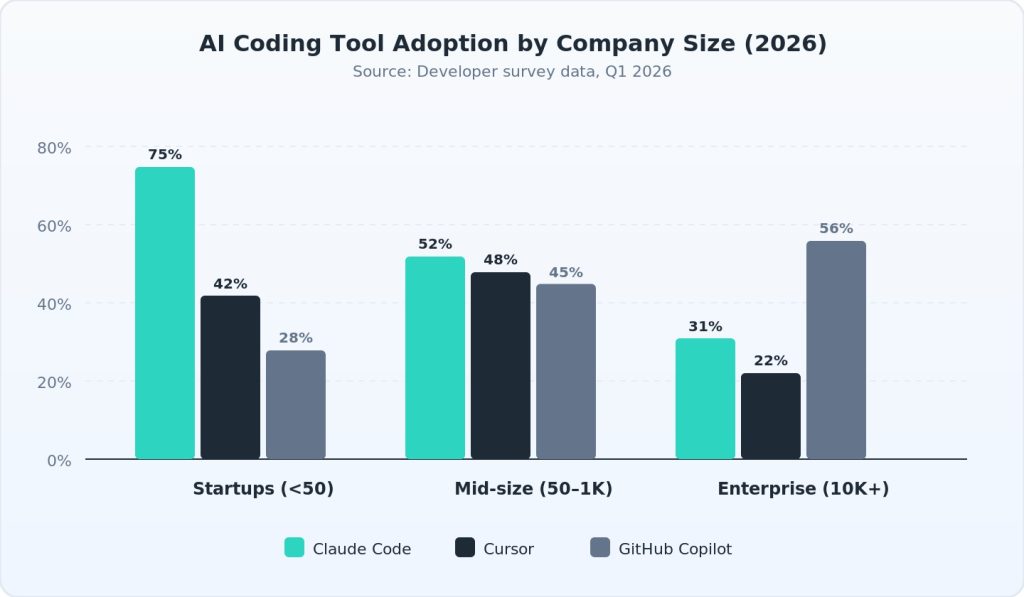
GitHub Copilot remains widely adopted, particularly at larger enterprises, but the developer tool market has clearly bifurcated. Startups and small product teams overwhelmingly favor Claude Code (used by 75% of small startups) and Cursor (42%), while Copilot dominates in enterprises with 10,000+ employees (56%).
The implication for anyone evaluating an AI development agency is straightforward: the tooling your team uses matters as much as the team itself. A nearshore AI development team that’s fluent in Claude Code, Cursor, and modern agentic workflows will outperform a larger, more expensive team that’s still writing code the 2023 way.
What a Nearshore AI Development Team Actually Looks Like
The stereotype of offshore development — a large, loosely managed team in a distant time zone writing code to a spec — has very little to do with how modern nearshore AI teams operate. The model we build at FBP looks more like a small, embedded product squad.
A typical nearshore AI development team for an early-stage or growth-stage product includes three to five people organized around clear functional ownership: a senior full-stack or backend engineer who serves as technical lead and owns architecture decisions; one to two mid-level engineers handling feature implementation and working directly with AI coding tools; a QA/DevOps engineer managing testing, deployment pipelines, and infrastructure; and in some cases, a product-focused generalist who handles requirements, stakeholder communication, and sprint coordination.
This isn’t staff augmentation in the traditional sense. It’s a self-contained product team — a unit that can take a product from concept through deployment, iterate based on user feedback, and maintain and scale the system over time. The “service as a software” model: you’re not renting hours, you’re engaging a team that owns outcomes.
The AI development teams we place are trained to work with agentic coding tools as a core part of their workflow. That means engineers who use Claude Code for complex debugging and multi-file refactors, Cursor for high-velocity feature development, and AI-assisted code review tools that catch issues before they reach QA. The result is a team of three that ships like a team of six — with cleaner code and fewer regressions.
The Cost Math: US vs. Nearshore AI Development Teams
The economics of nearshore AI development have always favored Latin America, but the AI tooling revolution has widened the gap further. Here’s how the numbers break down for a typical product team.
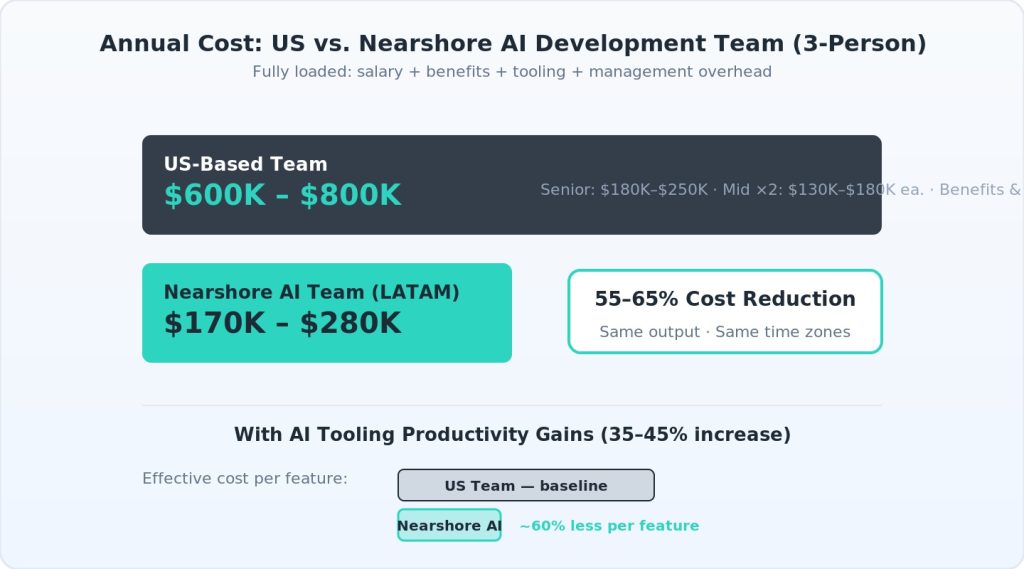
A mid-level AI-capable engineer in the US commands $130,000 to $180,000 per year. A senior engineer runs $180,000 to $250,000 or more. A three-person US-based team — one senior, two mid-level — costs $440,000 to $610,000 annually in salary alone, before benefits, tooling, office space, and management overhead. Fully loaded, that team easily exceeds $600,000 to $800,000 per year.
The equivalent nearshore AI development team in Costa Rica, Colombia, or Mexico: $170,000 to $280,000 annually, fully loaded. That’s a 55–65% cost reduction for equivalent output — and in many cases, superior output, because the nearshore developers we place are specifically selected for AI-tool fluency and trained to maximize the leverage these tools provide.
The productivity gains compound the savings. When your nearshore developers are shipping 35–45% more code per sprint thanks to AI-assisted development, the effective cost per feature drops even further. For a founder watching burn rate, this is the difference between 18 months of runway and 30.
Why Nearshore — Not Offshore — for AI Development
Geography matters more for AI development than for many other forms of software work, and the reason is collaboration density. Building AI-powered products requires tight feedback loops between engineering, product, and stakeholders. You need same-day code reviews, real-time architecture discussions, and the ability to pair-program across time zones without someone working at midnight.
Nearshore developers in Latin America — Costa Rica, Colombia, Mexico, Argentina — operate in US time zones or within one to two hours of overlap. That means your nearshore AI development team is online when you are. Stand-ups happen in the morning. Pull requests get reviewed the same day. Blockers get unblocked in hours, not in overnight handoff cycles.
This time zone alignment is the single biggest advantage nearshore has over offshore alternatives in India, Eastern Europe, or Southeast Asia. For AI development specifically — where iteration speed is everything and the difference between a good product and a great one is often measured in daily deployment cycles — real-time collaboration isn’t a nice-to-have. It’s a requirement.
The talent pipeline in Latin America has also matured significantly. Markets like Costa Rica and Argentina have invested heavily in STEM education and technology infrastructure. The region’s nearshore software developers are increasingly experienced with modern AI/ML stacks, cloud-native architecture, and the specific tooling (Claude Code, Cursor, LangChain, vector databases, RAG architectures) that AI software development demands. For companies exploring nearshore developers as an alternative to expensive domestic hires, the skill gap that existed five years ago has largely closed.
How Partnering With an AI Development Agency Accelerates Time to Market
The most expensive mistake in product development isn’t building the wrong thing — it’s building the right thing too slowly. Every month of delayed launch is a month of lost revenue, lost market position, and lost learning from real users.
Partnering with a nearshore AI development agency compresses time to market in three specific ways.
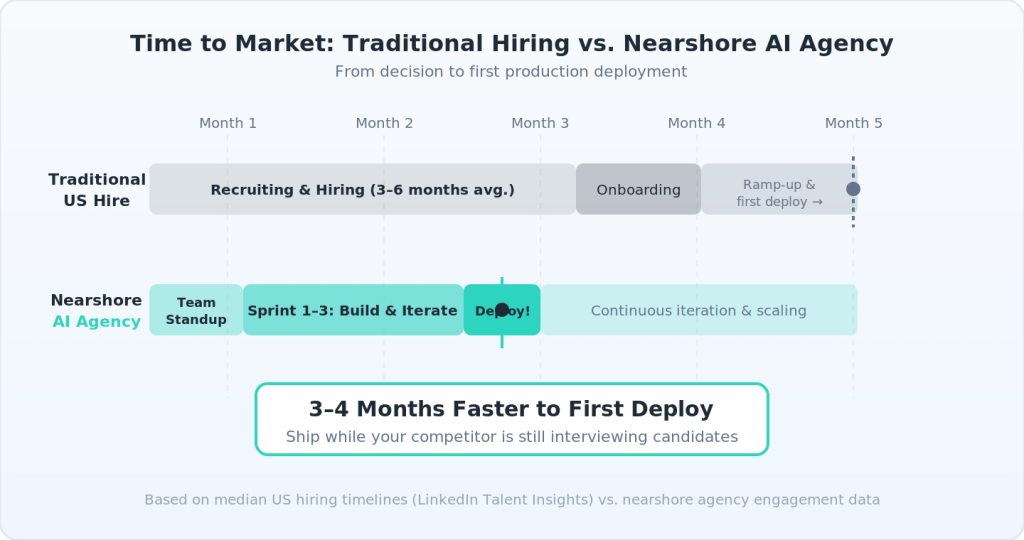
Speed to team formation. Hiring a US-based AI development team from scratch takes three to six months — if you can find the talent at all. The market for senior AI engineers in the US is intensely competitive, with median time-to-fill exceeding 90 days. A nearshore agency can stand up a fully operational, AI-tool-fluent product team in two to four weeks, because the recruiting, vetting, and operational infrastructure already exists.
Built-in AI workflow maturity. Your nearshore AI development team arrives with established workflows for AI-assisted development — not just familiarity with the tools, but production-tested processes for AI-augmented code review, automated testing, and continuous deployment. There’s no ramp-up period for “how do we use Claude Code effectively” because the agency has already solved that problem across multiple engagements.
Flexible scaling without fixed costs. Product development is not linear. You need more engineers during the build phase, fewer during maintenance, and the ability to surge capacity for major feature releases. A nearshore AI agency provides that elasticity without the overhead of hiring and layoffs. Scale up for a launch sprint, scale back during a strategy pivot, and never pay for idle capacity.
What to Look For in a Nearshore AI Development Agency
Not every nearshore partner is equipped for AI development work. The difference between a generic outsourcing shop and a genuine AI development agency comes down to a few critical factors.
First, look for demonstrated fluency with modern AI development tools. Your partner should be able to articulate specifically how their engineers use Claude Code, Cursor, and other agentic tools in their daily workflow — not as a checkbox, but as a core part of how they deliver. Ask for examples of how AI tooling changed the outcome on a recent project.
Second, evaluate the team model. The best nearshore AI agencies don’t sell you headcount — they sell you a product team with clear ownership, defined processes, and accountability for outcomes. That means dedicated engineers (not shared across clients), a defined sprint cadence, and direct access to the people doing the work.
Third, verify the talent pipeline. AI development requires a specific skill profile: engineers who are strong in fundamentals, comfortable with modern AI/ML frameworks, and — critically — skilled at working with AI coding assistants as a multiplier rather than a crutch. The agency should have a recruiting and vetting process that specifically screens for this.
Work With FBP on Your Nearshore AI Development Strategy
FBP works with founders and product leaders to design, recruit, and operationalize nearshore AI development teams across Latin America. We don’t just place engineers — we build product teams that are trained on the latest AI development tools, structured around clear delivery ownership, and optimized for the specific demands of building AI-powered software.
Whether you’re launching a new AI product, augmenting an existing team with nearshore developers, or exploring how nearshore AI development can reduce your burn rate without sacrificing velocity, we’d like to talk.